|
|
Hosta Virus X A new threat to one of our favorite shade perennials. |
|||||||||||||||||||||||||||||||||||||||||||||||||||||||||||||||||||||||||||||||||||||||||||||||||||||||
|
Last autumn a friend called and asked me if I had heard about a new virus infecting hosta. I told her that I had heard a little about it earlier in the season, but since then nothing. I hate to say it, but I was almost hoping that if I ignored it, the whole thing would turn out to be a non-event. After all, almost every gardener I know has at least one hosta, and most have quite a few.
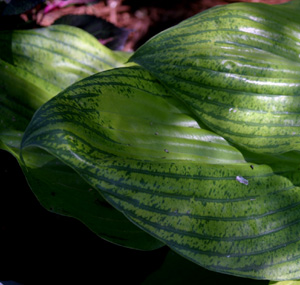
Well, my friend is not one to ignore anything and she started then and there to research the virus so that she could present her findings to our Horticultural Society. She did, and boy is it scary. What was once one of the most bulletproof and easy to grow perennials is now being struck down by the Hosta Virus X (HVX). HVX first started showing up about five years ago when plants with interesting markings and mottled foliage were noticed growing in nurseries and backyards. The irony is that not only was it not identified as a virus, but some of the infected plants were even thought to be new sports (varieties) of hosta and actually named and propagated here in the U.S. and Europe. Some examples of hosta that were sold as new varieties, but instead were simply plants infected with HVX, are 'Breakdance,' 'Lunacy' and 'Leopard Frog.' Unfortunately, at some point HVX infected plants reached Holland where the wholesale growers manage huge fields of plants. For a few years some infected plants were noticed and removed from their fields, but what they didn't realize is that if one plant is infected chances are ALL plants are infected. That means that Holland has been shipping infected plants to nurseries all over the world for no one knows how long. Pretty bad, eh? Well, it gets worse. The hosta that most commonly carries HVX is also one of the most popular, 'Sum and Substance.' Another popular hosta that is a common carrier is 'Gold Standard.' Yikes! I don't know about you, but I have both of them growing in my backyard. So how do we know if they are infected? As Shakespeare said, "Aye, there's the rub." Most hostas infected with HVX don't even show symptoms for years. 'Sum and Substance' can even take up to 7 years. That doesn't mean that they will not die eventually, because they will. It also does not mean that if they look normal they can't give it to other hosta, because they can. Some symptoms of HVX to look for are darker veins that have an "ink-bleeding" look similar to what ink does when it falls onto a tissue. Also look for leaves that are mottled and discolored such as gold leaves that have darker green spots. You might even notice that a hosta that always did well before suddenly has bleached areas even though it isn't in strong sunlight. What does it all mean? It means that we must be a lot more conscientious when it comes to hosta maintenance. This virus is spread by sap in all parts of the plant including the leaves, the stems and even the roots. If you do have an infected plant, dig it up immediately and throw it into your garbage...not your compost heap or even your brush pile. Then sterilize your shovel with a bleach/water mixture. As long as you have gotten all the roots and every bit of living tissue, you can replant a healthy hosta back into the same area. When deadheading or dividing hostas, sterilize your tools with a bleach/water mixture between plants...even if they appear healthy. As I said before, most plants don't show symptoms until long after they are infected. Lastly, don't buy plants that have any of the obvious markings I've described. In fact, since this is a fairly new discovery, be sure to tell someone at the garden center if you do find an infected plant. I'm sure they will appreciate being educated about this new threat and if we are going to lick this, we all need to do our part. UPDATE 2006: Below is a list of susceptible hosta varieties put together after a 3-year trial by Dr. Ben Lockhart , University of Minnesota. (Note that 'Sum and Substance' is nowhere on the list!). Page
Two: More photos of HVX infected plants. |
||||||||||||||||||||||||||||||||||||||||||||||||||||||||||||||||||||||||||||||||||||||||||||||||||||||||
|
Dr. Ben Lockhart, Univ. of Minnesota. (This
information is based on a three year trial in Minnesota; see notes below. Find
the complete article at .)
|
||||||||||||||||||||||||||||||||||||||||||||||||||||||||||||||||||||||||||||||||||||||||||||||||||||||||
|
1 All or most of the plants tested positive the first year. 2 All or most of the plants tested positive by the end of the second year. 3 Half or fewer of the pants tested positive for the second year. 4 No plants were infected the first two years, but one or more plants tested positive by ELISA or ISEM the third year. 5 No plant tested positive by the end of the third year. 6 If fewer than four plants were available for the first two years, the number of plants in the study is indicated in the parentheses. In a few cases there were fewer plants the second year than in the first year because of winter injury. These were as follows: H. 'Bright Lights' had four plants resistant the first year, and the only surviving plant susceptible the second. H. 'Tokudama Aureonebulosa' had one plant that tested positive the first two years, but only three plants were present the second year. H. 'Color Glory' had four plants the first year and only three plants the second year, with no plants ever testing positive. |
||||||||||||||||||||||||||||||||||||||||||||||||||||||||||||||||||||||||||||||||||||||||||||||||||||||||