|
|
"Bulletproof" Annuals |
||||||||||
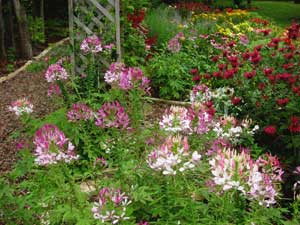
It is the middle of summer--and maybe your gardens are still looking a little bare in some spots. Perennials are wonderful, but most take at least two or three seasons to fill in and look their best. So what do you put in those holes that stick out like a sore thumb right in front of your borders? That's where "bullet-proof" annuals come in handy. Annuals have some advantages over perennials. Most have a longer flowering season so you can rely on their constant color in the border. They also aren't permanent or expensive, so you can change your planting scheme each year. The only negative about some of the annuals below is that maybe they are a little overused. The reason for this makes the negative...a positive. They are all amazingly easy to grow and stay looking good all summer. If you are new to gardening, annuals are flowers that live for only one season. I prefer a combination of both perennials and annuals. That way I have some latitude to change, but yet have some static form to the garden. One of the most durable annuals is wax begonia (Begonia semperflorenscultorum). I have a place next to the basketball court where nothing else had survived. The begonias have withstood wayward basketballs and stomping children and still performed beautifully. They grow in shade or some sun and come in white, pink, rose or red. Don't confuse them with tuberose begonias. They take a little more TLC then the wax begonias. Another good shade annual is the ubiquitous impatiens (Impatiens wallerana). This is definitely a case of overuse with good reason. They are the perfect plant. They spread quickly to cover the bare spots and choke out weeds and they come in many lovely shades of pink, white and rose. With all their attributes it's no wonder it's the most popular bedding plant in our country. My favorite light shade annual is lobelia. I'm very partial to its small cobalt blue blossoms. I plant it with all may container plants so it will drape over the side. It does gets a little ragged in the middle of the summer, so I shear the top off and soon it is flowering again. There are either mounded or trailing varieties. A good annual for the front of a sunny border is sweet alyssum (Lobularia maritima). It has a sweet honey fragrance and is available in rose, purple or white. It self-sows readily so you may have them next year, as well. Plant them close together to give a carpet-like effect. Two taller annuals that aren't as readily available at the nursery, but well worth looking for, are calendula (C. officinalis) and cleome (C. hasslerana). Calendula is an edible flower that deserves a place in every garden. As long as you keep the spent yellow or orange flowers removed, your will have blossoms all summer long. They withstand hard freezes and will still be standing long after the other annuals have succumbed to frost. It is another self-sower, and will appear in your garden for years to come. Cleome are an old-fashioned favorite that I first saw in Florida. They were planted in front of an all white stucco house and had a very contemporary and architectural look. They come back every year in my gardens in shades of pink, rose, and deep purple, and are very showy in back of the border. They can grow to five feet tall in a sunny location. In less then perfect conditions, they grow to about three feet. If you don't find them at the nursery this year, buy seeds and direct sow them next year. There are many other annuals still available at the nurseries this time
of the season. Most are tried and true favorites so if you'd like a variety
that's a little different--try starting your own next year.
There are few
things more satisfying then raising plants from seed to flower.
|
|||||||||||
|
|
|||||||||||