|
|
The Minnesota Tip Terry L. Yockey |
|||
|
When the weather begins to cool, it's time to start preparing your tender roses for the winter months. Discontinue your fertilization program and begin to harden your bushes by letting some of the blossoms go to seed. One way to jump-start the seed production is to pull the petals off a few of the blooms. In mid-October choose your method of winter protection. There are several including mounding or hilling, rose cones, or the one I'll be describing in this article--the Minnesota Tip. It was invented here in Minnesota by Albert I. Nelson, and is the most dependable way to get your tender roses through the coldest months. The first step is to carefully tie the canes together with twine. Weave
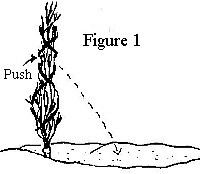
the twine around the rose bringing all the canes tightly together (see
Figure 1). When you have finished binding the canes, water the area generously. After the water has all soaked in and the ground isn't mushy, (and being careful not to damage any roots!), dig a six to eight inch trench out from the base of the plant. The trench should be wide and tall enough to accommodate your rose. You can even bury several in one large trench if you would prefer. Then loosen the soil around the bush using a spading fork. Pull the soil away and gently push the plant into the trench (see Figure 1). Some of the roots on the back may pull loose, but this is normal and won't harm your rose.
Keep the area well watered until the soil starts to freeze. When the ground is frozen, cover the bed with about 18 inches of loose leaves to keep the area frozen during early thaws. When spring arrives, wait until the entire rose bed is unthawed and beginning to dry out. If you have to pry the stems out of the ground--it's too early to lift the roses! It is also important to wait until the area isn't too muddy. If you go in to your beds too soon you may ruin the soil structure. On the other hand, if you wait too long the buds will begin to grow while still under ground. This will weaken your rose bush and make it more susceptible to disease later in the season. Once the rose is out of the ground, untie the twine and spread out the branches. A good spraying with the hose will remove all the dead leaves and any remaining mulch and dirt. After a winter nap and spring shower--your roses should be ready for another gorgeous season of blossoms! |
||||
|
"," by John Whitman and Jerry Olson, Contemporary Books.
Hardcover - 272 pages (January 1999).
|
||||

 Place
something on the rose to hold it down temporarily and then finish filling
the trench and covering the entire rose bush with dirt (see Figure 2).
Make sure you mark the top of the rose so you can easily find it next year.
Place
something on the rose to hold it down temporarily and then finish filling
the trench and covering the entire rose bush with dirt (see Figure 2).
Make sure you mark the top of the rose so you can easily find it next year.