|
|
Centaurea Fact Sheet |
||||
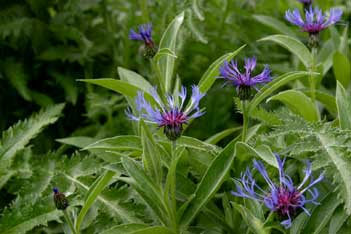
No matter what you call them--cornflowers, bachelors buttons, basket flower, or the old-fashioned blue-bottle--members of the genus Centaurea are wonderful additions to a garden. Even if they werent great cut flowers, which they are, the blue color of the species would make them desirable. They have been grown in American gardens since Colonial times, primarily from seeds brought over from Europe. History Most centaureas originated in Europe, where they still inhabit fields and waysides today, but a few are native to the Americas. They have been part of gardens for centuries, going back to ancient times. In fact, the genus name, Centaurea has its basis in Greek mythology. One of the centaurs, Chiron, is said to have used the flower to heal wounds, including his own, after battle. The most peaceful of the centaurs (who were a warlike group of half man-half horse), Chiron is credited in myth with teaching mankind about the healing powers of herbs. In spite of that history, cornflowers werent as established as medicinals as other herbs, perhaps in part because of confusion with centaury (Centaurium, now known as Erythraea centaurium), which has a similar name but very different flower color. Both were thought to be beneficial for eye ailments--understandable for cornflowers because of their blue color. In the mid-1600s, herbalists such as John Gerard and Nicholas Culpepper included cornflower, or blew-bottle, in their books on useful herbs. Culpepper claimed the dried leaves could be used as a remedy against the poison of the scorpion, if they were mixed in water with plantain or comfrey. Modern herbalists dont advocate that, but they do consider a decoction of the leaves useful as an eye lotion. Whats in a Name? There are many species of centaurea, but the most readily available as seeds or plants are Centaurea cyanus, cornflower, or bachelors-button; C. americana, basket flower; and C. montana, mountain bluet, or perennial cornflower. Cornflowers are appropriately named--they grow wild in corn fields in Europe and the United States and bloom basically until the harvest season begins. The term bachelors-button refers to the long-lasting quality of the flower when it is cut and placed in the buttonhole of a suit or shirt; decades ago, bachelors sported the flower when they went courting. The origin of bluet in mountain bluet is from France. The blooms of basket-flower give it its name: Because of the ray-like outer petals, the heads look as if they are set in a shallow basket. Annual bachelors-buttons and basket-flowers begin to bloom in late spring and continue through summer. C. americana, an annual native to the south central and southeastern United States, is hardy to Zone 4. Centaurea can tolerate low temperatures of 41 degrees Fahrenheit. Native to the mountains of Europe, mountain bluet flowers from late spring to early summer. It is hardy to Zone 3 and produces fringed, violet-blue flowers with deep purple centers. Also a member of the Centaurea genus is the well-known bedding plant dusty miller. A perennial, C. cineraria is grown for its grayish foliage, not its rather unattractive purple flowers. Even though it is perennial to Zone 4, its best to treat it as an annual; it doesnt come through winter looking very good. Some species, which you wont find for sale, are unwelcome in gardens and fields because they are noxious weeds. Known variously as knapweed and hurt sickle, they were introduced from Europe, and they crowd out more desirable native plants. Hurt sickle refers to the ability of the tough stems of the plants to dull, and sometimes break, a farmers sickle back in the days of hand-reaping. Knapweed comes from the rounded, knobby flowerknap is an older English form of knob. They are not plants for a gardenor anywhere else, for that matter. Flower and Plant Forms Centaureas produce single and double, fringed blooms on plants that range in height from 10 inches to 2-1/2 feet, depending on the species or cultivar--basket flower can reach 4 feet in height. The shape of the flower petals resembles that of thistles, but the plants leaves do not have the spines of the latter! The leaves are often an attractive gray-green. Mountain bluet grows about two feet tall with an equal spread. The flowers are usually lavender blue, but you may also find plants with rose, pale yellow, or white blooms. Tall and double-flowered forms are particularly valuable in a cutting garden. Dwarf forms of centaurea, especially the Florence series and the Midget mixture, with their 10- to 20-inch height and naturally compact, bushy growth habits, are good choices for edging a garden or filling out a container. Colors include violet, red, pink, lavender, blue, and white. Growing from Seed Centaureas are very easy to grow from seed started indoors or out. The taller varieties, which are so useful in cutting gardens, may not be readily available as plants at garden centers and should be started from seed. Perennial mountain bluet simply takes a little longer to germinate than the annual kinds; started early enough, it may bloom the first year it is planted. Sowing Outdoors According to the National Garden Bureau, you can sow annual centaureas outdoors in late September in mild winter areas; they will start to grow before the first fall frost (if any) and will bloom earlier the following spring. In colder zones, sow seeds in early spring as soon as the ground can be worked. Sow perennials in early spring or fall.
Starting Indoors Sow seeds indoors about one month before you want to plant the seedlings outdoorswhich you can do as soon as the ground can be workedor before the average last spring frost in your area. Some annual bachelors-buttons, such as the Florence series, are day-length sensitive: They need at least 14 hours of daylight to set flower buds, so you may want to supplement natural light with fluorescent or grow lights for earliest bloom. The National Garden Bureau suggests the following:
Selecting Plants at the Garden Center In addition to growing centaureas from seed, you can purchase potted plants at a local garden center or nursery. You may be able to find small, young, green plants as well as those in flower. Because of their compact habit, dwarf centaureas, like the Florence and Midget series, may be more readily available in bloom. Look for plants with a lot of buds and only a few, if any, open blossoms. Avoid leggy plants and those that are single stemmed; you want to start out with compact, well-branched plants, especially because of the centaureas habit of becoming leggy as the season progresses. The leaves should not be wilted, even though they are likely to recover when you get them home and plant them. Be very watchful for signs of disease, such as powdery mildew and rust. Some garden centers sell pots or flats of mixed colors, but many offer packs of blue bachelors-buttons, simply because it is the most common color. If you cannot put the plants in the garden right away, water them well and set the pots out of direct sun until you can do so. Transplanting Plant centaureas in full or partial sun in any average, slightly alkaline soil. Although they are not too particular about fertility, you may want to dig some compost or dried manure into the soil before plantinga 1- to 2-inch layer should do. In hot zones, such as 8 to 10 and desert areas, bachelor-buttons will grow better with some shade from the midday sun. - Transplant on a calm, cloudy day, so the plants can begin to get acclimated before having to contend with sun and wind. - Space the annuals about 12 inches apart. Give the perennials room to spreadspace them at least 2 feet apart. - Taller varieties (including mountain bluet) may need support, because the stems have a tendency to become floppy as they grow. Stake or cage them when you transplant. - Water the plants well immediately after planting. Out in the Garden All centaureas look good as part of an informal or wildflower garden. They are especially attractive interplanted with red poppies and snapdragons, or mixed with daylilies in a border. They also belong in cutting gardens in mixed color combinations or in blocks of individual colors. The foliage may become rather ragged and unbecoming as the season progressesespecially if the season has been rainy or very hotso set plants in borders or beds where the leaves and flowers of other annuals and perennials will camouflage them. - Many bachelors-buttons branch naturally, but you can pinch the growing tips to encourage more branching, bushier growth, and more flowers. C. americana does need to be pinched, or you may end up with single-stalked plants. Pinching perennial cornflower will also give you more flowers, but it isnt required. For slightly larger flowers, you can remove the buds from young plants, but part of the charm of cornflowers is their small, thistle like blooms. - Perennial cornflower spreads very quickly by means of underground stolons to cover any good, unplanted soil. To control it in a garden bed, dig up and divide the plants every two years. It prefers cool climates and does not grow well in areas with hot, humid summers. - Fertilize the plants monthly with a balanced fertilizer or use a slow-release plant food at transplanting time. - Water infrequently; centaureas are drought tolerant, and the stems actually get rather floppy if the soil is too moist. - Remove spent flowers to keep the plants producing new blooms. - Centaureas will self-seed, but not reliably and not for more than a year or two. It is best to start annuals with fresh seed every year. Cut-Flower Bonanza Centaureas are excellent flowers for cutting, whether you want to use them fresh or dried. Freshly cut blooms last 4 to 5 days. The dried flowers retain their colors: Use the petals to add bright hues to potpourri, or use the whole flowers in arrangements. For fresh arrangements, most gardeners grow the standard or taller cornflowers, but dwarf bachelors-buttons also have their uses. Cut the blooms in early morning when they are half open and strip the lower leaves from the stems. Bachelors-buttons combine beautifully with snapdragons, sweet william, love-in-a-mist (Nigella), lavender, and the blue spikes of Salvia farinacea (Victoria) and red spikes of Salvia splendens. The plants grayish foliage harmonizes with the silvery leaves of artemisia and dusty miller. Centaureas provide an informal, airy look with floribunda and shrub roses. Use them in nosegays and swags as well as in vase arrangements. Try wiring small bunches of the blooms to napkin rings for a special occasion; the dwarf Florence series works well in that design. The smaller flowers are also delightful in miniature arrangements. And, of course, go for tradition: Deck out a buttonhole with the flowersthree to five stems backed by a bit of fern. To dry whole blooms, pick them after the sun has evaporated the dewin late morning or in the afternoon. Select flowers that have just opened or they will drop their petals when dry. You can air-dry the flowers by tying 6 to 7 stems together in bunches and hanging them upside down in an airy, dark place for 2 to 3 weeks. You can also dry them in a desiccant, such as silica gel: In a container with a lid, cover the flowers, with 1-inch stems attached, completely with silica gel; close the lid; the blooms should be dry in about 5 days. Dried cornflowers combine well with such dried flowers as strawflowers, everlastings, roses, zinnias, and lavender. Centaureas in Containers Because centaureas are quite drought resistant, they do very well in containers, where the soil can dry out quickly. Plant them in window boxes or standard containers in combination with other annuals, such as geraniums, zinnias (Z. angustifolia in particular), lobelia, fan flower (Scaevola), and dusty miller. Dwarf varieties, such as the Florence series, are the most adaptable to window boxes.
Diseases and Pests About the only pest that may bother cornflowers is the aphid. Aphids are easy to deter simply by washing the plants off with a strong spray of water from a garden hose. In wet weather, two fungal diseases may be a problem: rust and powdery mildew. You can help prevent powdery mildew by spacing the plants so there is good air circulation. Watering from below, so you dont wet the leaves, helps as well, but theres not too much you can do to protect them from natures rain. Remove infected leaves as soon as you see them. To control rust, spray with a fungicidal soap or sulfur. Remove affected leaves and stems (dont compost them). Use drip irrigation instead of a hose to water the plants. The National Garden Bureau recognizes Eleanore Lewis as the author of this fact sheet. Two experts reviewed the text for accuracy before publishing. We thank Dennis Kromer of Wild West Seed Inc., and Albert Stuurman of PanAmerican Seed Company for checking the text for the Bureau. The Year of the Centaurea is provided as a
service from the National Garden Bureau. The National Garden Bureau is a
non-profit organization and recognizes the seed company members that generously
donate funds for the educational program. |
|||||
|
|
|||||